American Progressive
Educational Practices
and Their Application in Foreign Language Accusation –
A Historical
Prospective
Dawn Yonally, Ph.D.
Global Institute of Management and Economics
Dongbei University of Finance and
Economics
Dalian, China
Education in the United States
is a mosaic that has evolved over two hundred years. These advancements have
occurred through research, international connections, historical developments
and political changes. This journey has forever changed the face of American
education.
John Dewey (1859 - 1952) is considered the
father of American educational philosophy. He is well known for stating, school
is a reflection of society, values are relative to social situation of a
country and democracy would be wide-spread accepted by rational people. He
believed in active participation by learners. In addition, they should be
exposed to many different subjects at school, so they can make informed
decisions concerning what they are interested pursuing in the future.
Historical documents have had
a profound effect on educational development. The American Declaration of
Independence states that “all men (people) are created equal and endowed by
their Creator with certain unalienable rights” – rights such as “life, liberty
and the pursuit of happiness.” In addition, the U.S. Constitution reports that
the purpose of government is to secure rights and broadens the purposes of
government to include forming “a more perfect union, to establish justice, to
insure domestic tranquility, provide for the common defense, promote the
general welfare, and secure the blessings of liberty to ourselves and our
posterity.”
How does effect education? It
gives value and direction. They help direct the schools’ roles in
student-teacher relations. Students are to participate in governance of the
school. Student-teacher-parent-district are to form a
strong bond and support each other. Parents are to be involved in district
review committees. There are rules guiding student participation and behavior
on school campuses. District-state-federal policies and issues are divided to
provide separate levels of support and responsibilities. District-teacher
negotiations are held to be right of local control for districts. This division
of responsibilities reflects commitment of local control, personalization and
involvement. These partnerships have a direct effect on innovation, educational
excellence and student-centered education.
What is the role of curriculum
theory and where does it come from? First,
it comes from the social situation - historical and cultural issues which are
formed by and are forming a people or nation (Ornstein, 1989; Bloom, 1987).
Secondly, is the current political situation (Apple, 1988).
This includes the constitution of the nation or state, the Department of
Education, and the policy makers in the legislature (Timar
and Kirp, 1988). Thirdly, the experience of, and
experiments concerning, the learners and the learning process of which there
are three: a. psychology of learning, b. all experimental data and c.
teacher-student experience (Shulman, 1987). The philosophy of education focuses
on the values about the nature of humanity, the purpose of life and on personal
relations which form the core issues of any particular philosophy (Bell and Schniedewind, 1987).
What aspects of life does
curriculum theory spring? There are four areas of life: political, social,
economic and religious (Schubert, 1985; Waks, 1988).
The four values of American education are a combination of sociological
descriptions (Wildavsky, Rokeach).
The first is freedom: corporate, economic, personal and religious. The second
is the nuclear family as the foundation of society. The third is the value of
the individual, within the group; therefore, equality of opportunity between
individuals. Lastly, personal and social justices (Gutmann,
1990) are important values in curriculum theory.
So, what does that look like
in the classroom? One model is the ADDIE Model. It is a systematic
instructional design model with five phases: analysis, design, development,
implementation and evaluation.
In the analysis phase the
designer identifies the learning situation, the goals and objectives. The
audience’s needs, existing knowledge and any other relevant characteristics
must all be considered. The learning environment aspects include the
constraints, delivery options and timeline for the project. Each situation is
different and must be taken into account. For example, the age of the learner,
what is to be learned, the available resources such as the building, educators,
teaching supplies and setting must be considered.
The design phase is a
systematic process of specifying learning objectives. They consist of detailed
storyboards and prototypes. They are very descriptive. Graphic design is an
important element to help explain the learning objectives. User-interface is of
prime importance and the content is determined by the educator to best help the
learner achieved the state objectives. The design phase is the actual creation
and production storyboards and prototypes to depict the objectives. Content and
the learning materials are based on the design phase.
During the
development phase instructional designers and developers create and assemble
the content. Programmers develop and/or integrate technologies, and debug if
e-learning is involved. The feedback is reviewed and needed changes are
completed.
Implementation is when the
plan is put into action. Procedures for training the learner and teacher are
developed. Materials are delivered or distributed to the student groups and the
effectiveness of the training materials is evaluated.
Evaluation is divided into two
parts: the formative evaluation - each stage of the process and the summative
evaluation consists of tests designed for criterion-related referenced items
and providing opportunities for feedback from the users. Revisions are made as
needed at this stage.
Two people who had major
influences in American education are Jean Piaget (1896-1980) and Lev Semyonovich Vygotsky (1896 – 1934). Piaget was a Swiss
psychologist and educator, whose major contribution was to learning theories
based on different stages in the development of children's intelligence. Vygotsky (Russian:
Лев Семёнович Вы’готский or Выго’тский, born Лев Симхович Выгодский - Simkhovich Vygodsky)
was a Russian psychologist, the founder of an original holistic theory of human
cultural and biosocial development commonly referred to as cultural-historical
psychology.
Piaget’s theory addressed
cognitive development and stated children construct their knowledge. He was the
first one to attempt to explain development. His theory is now considered
reasonably accurate overview of how children of different ages think. The body
of work he generated over his lifetime had a major influence on the way people viewed
children’s social and emotional development, education and influenced future
research.
Vygotsky’s sociocultural perspective is concerned with
the social origins of early cognitive competencies. He concluded many
discoveries active learners make occur in collaborative dialogue with a tutor.
This has been referred to as the Zone of Proximal Development (ZDP). This
explains the difference between what a learner can do independently and what
can be done with guidance.
The Zone of Proximal
Development has tools for intellectual adaptation. Vygotsky believes children are born with
elementary mental functions
- attention and memory. Culture transforms these into higher
mental functions and culture specific tools allow the use of the basic
functions. These functions are adaptive to different cultures. Children learn
to use the language and writing tools of their culture and this can affect
development.
Vygotsky also addressed the social origins of early
cognitive competencies. Many discoveries active learners make occur in
collaborative dialogue with a tutor. There are difference between what a
learner can do independently and what can be done with guidance.
The term of scaffolding is
another major contribution of Vygotsky’s work.
Scaffolding is the tailoring of support to a learner near the limit of
capability. Scaffolding occurs when the educator guides the learner threw
progressively more complicated stages, building for previous knowledge.
But what are the implications
for education? Students must be active, not passive when learning. Educators
must assess what is known to estimate capabilities of the learner. Guided
participation structured by teachers, who would gradually turn over more of
activity to students, is an integral part. Through cooperative learning
exercises students help educate each other. It is extremely effective as
students guide each other from the unknown to the known.
Constructism is a learning theory that was built on
theories of Piaget and Vygotsky which is based on
observation and scientific study about how people learn. During constructism learners construct their own understanding,
develop knowledge of the world, through experiencing and reflecting on those
experiences.
Constructivist view of
learning utilizes different teaching practices. It encourages students to use
active techniques (experiments, real-world problem-solving), to create more
knowledge and to reflect on and talk about what they are doing. Students
understand changes through experiments and real-world problem-solving. Teacher
makes sure he/she understands the students' preexisting conceptions and guides
the activity to address them and then build on them. Constructivist teachers
encourage students to constantly assess how the activity is helping them gain
understanding and through questioning themselves. Students in the
constructivist classroom ideally become expert learners, and have
ever-broadening tools to keep learning. With a well-planned classroom
environment, the students learn how to learn.
Project-Based Learning (PBL)
in school is based on Vygotsky’s research. Students
explore a topic; produce a written or oral presentation. Presentation media may
include photos, video and audio. Written presentation may be a standard hard
copy written paper.
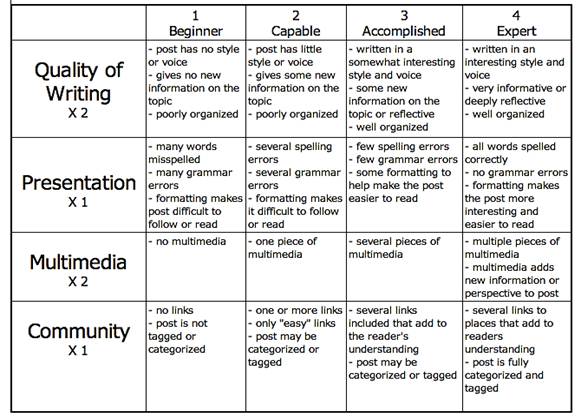
Assessment of PBL uses
rubrics. They communicate expectations of quality and content. The development of a rubric is crucial.
Students should help develop assessment criteria and learn to self-assess.
Students learn to assess other students’ work using multiple methods of
assessment. It
is authentic assessment. (See example below)
Thomas L. Friedman and Michael
Mandelbaum in a recent book, That Used to be US” What Went Wrong with America - and How it Can Come
Back, have updated some of these aspects. Thomas Friedman is best known for
his runaway hit, The World is Flat, which explored how people and nations can be successful and are
connected. In one chapter Friedman and Mandelbaum
addressed education and wrote about work of Tony Wagner, who is the Innovative
Education Fellow at the Entrepreneurship Center at Harvard. He authored The
Global Achievement Gap, Learning to Innovate
and Innovating to Learn. He believes all students must be proficient is in critical thinking, effective oral and
written communication and collaboration. He refers to these as the three Cs. “It
is about asking the right questions – rather than about memorizing the right
answers.” These accurately reflect the works of Piaget and Vygotsky.
Education in the United States has been allowed to
draw from many sources – research, historical, political and international. The
bringing together of these will yield the brightest future for all involved.
The success or survival of a culture may depend on it.
References
1.
Apple, Michael. (1979).
Ideology and Curriculum. London: Routledge & Kegan Paul.
2.
Apple, Michael. (1988).
"School Crisis and Curriculum Accords," Educational Theory, 38:2.
3.
Bell, Lee and Schniedewind, Nancy. (1987). "Reflective
minds/intentional hearts," Journal of Education, 169:2, 55-77.
4.
Bloom, Alan. (1987). The Closing of the American Mind. NY: Simon and Schuster.
5.
Dick, W., & Carey, L.
(1996). The Systematic Design of Instruction (4th Ed.). New York: Haper Collins College
Publishers.
6.
Gutmann, Amy.
(1990). "Democratic education in difficult times," Teachers College
Record, 92:1.
7.
Leshin, C. B.,
Pollock, J., & Reigeluth, C. M. (1992). Instructional
Design Strategies and Tactics. Englewood Cliffs,
NJ: Education Technology Publications.
8.
Ornstein, Allan. (1989).
"Private and Public Schools Comparisons," Education and Urban
Society, 21:2, 192-206.
9.
Rokeach, Milton.
(1973). The nature of human values. NY: Macmillan.
10.
Schubert, W. (1985). "The
foundational character of curriculum inquiry," Educational Considerations,
12:1, 4-7.
11.
Shulmann, L. S.
(1987). "Knowledge and teaching," Harvard Educational Review, 57:1,
1-22.
12.
Timar, Thomas and
Kirp, David. (1988). Managing Educational Excellence.
NY: Falmer.
13.
Wildavsky, Aaron.
(March, 1987). "Choosing preferences by constructing institutions: A
cultural theory," APSR 81:1, 3-21.
14.
http://www.youtube.com/watch?v=LMeVx17lKbc&feature=youtu.be